T2.5 — RoPE and the Long-Context Boundary
In one line: RoPE encodes relative position by rotating query and key pairs, but extending the position range changes both the model’s learned geometry and its memory cost.
| Skill | 00-foundations |
| Module | M2 — Transformer Internals from the Inference Angle |
| Audience | New graduate engineer |
| Time | ~110 min |
| Prereqs | T2.2; sine, cosine, and vector dot products |
| Status | built |
Why this matters
Changing max_position_embeddings does not teach a model to use longer contexts. Even when a scaling method preserves quality, every additional cached token consumes memory and attention work, so the usable context window is a systems limit as well as a modeling limit.
The mental model
RoPE treats pairs of vector coordinates as points on a two-dimensional plane. Moving to a later token position rotates each pair. Different coordinate pairs rotate at different frequencies: some turn quickly and capture short positional differences; others turn slowly and preserve broader structure.
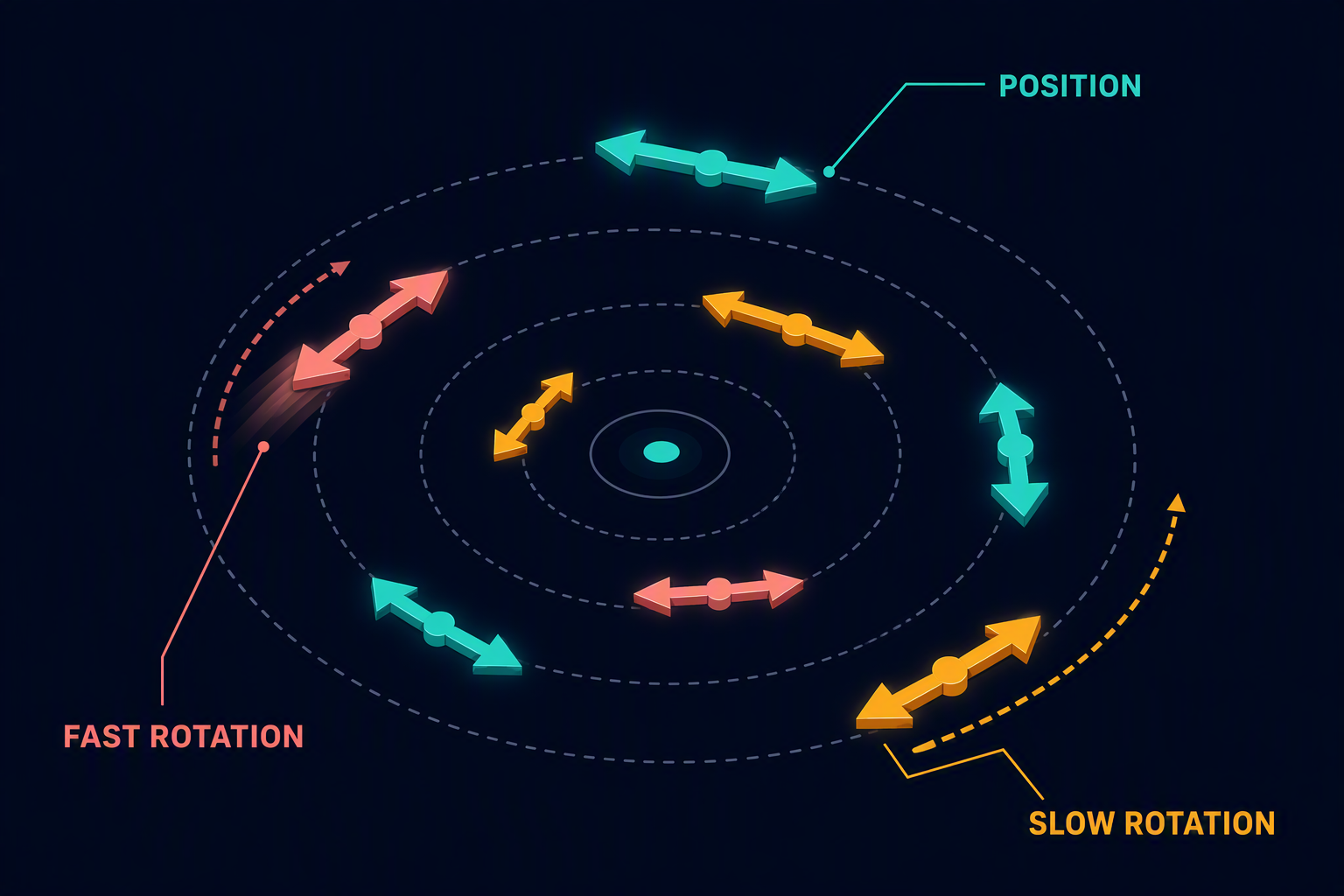
RoPE turns coordinate pairs by position-dependent angles at several frequencies.
When a query at position p is dotted with a key at position q, their rotations combine so the score depends on the relative displacement p-q. RoPE therefore inserts position into attention without adding a separate position vector to the residual stream.
flowchart LR
    Q[Query pair at p] --> RQ[Rotate by p × frequency]
    K[Key pair at q] --> RK[Rotate by q × frequency]
    RQ --> D[Dot product depends on p − q]
    RK --> D
Absolute rotations produce a relative-position effect inside the query–key dot product.
The mechanism
Take a coordinate pair \((x_0,x_1)\). Rotation by angle \(\theta\) gives
RoPE chooses a frequency \(\omega_i\) for each pair and uses angle \(p\omega_i\) at position p. A common schedule is based on a configurable rope_theta, often written as
Large frequencies rotate quickly; small frequencies rotate slowly. The full head contains a mixture of positional scales.
For a simple picture, rotate (1,0). At zero degrees it stays (1,0), at 90 degrees it becomes (0,1), and at 180 degrees it becomes (-1,0). RoPE applies this ordinary operation to many coordinate pairs at once, using different angles for each pair and position.
Why relative displacement appears
Rotation matrices satisfy \(R(p)^TR(q)=R(q-p)\). Therefore
You do not need to memorize the matrix identity. Its meaning is simple: rotating both vectors by their absolute positions makes their dot product sensitive to how far apart the positions are. Content remains in the vectors; position changes how content matches.
Why editing the maximum is insufficient
Suppose a model trained only to position 4,096. Setting max_position_embeddings to 32,768 may allow a framework to allocate longer tensors, but it does not change the rotation pattern the model learned to interpret. At new positions, fast frequency components may cycle through patterns never encountered in training, and attention behavior can degrade.
Position-interpolation methods slow or reshape rotations so a longer requested range maps into a more familiar phase range. Simple linear scaling maps position p to p/factor. NTK-aware methods modify frequency behavior nonuniformly. YaRN combines frequency-dependent interpolation with additional corrections. These methods are not interchangeable config spellings; use the method and parameters validated for the specific checkpoint.
With linear factor four, requested position 8,000 rotates like unscaled position 2,000. This stays inside a familiar phase range but compresses distance: two tokens 400 positions apart appear 100 scaled positions apart. The method buys range by changing positional resolution, which is why evaluation remains necessary.
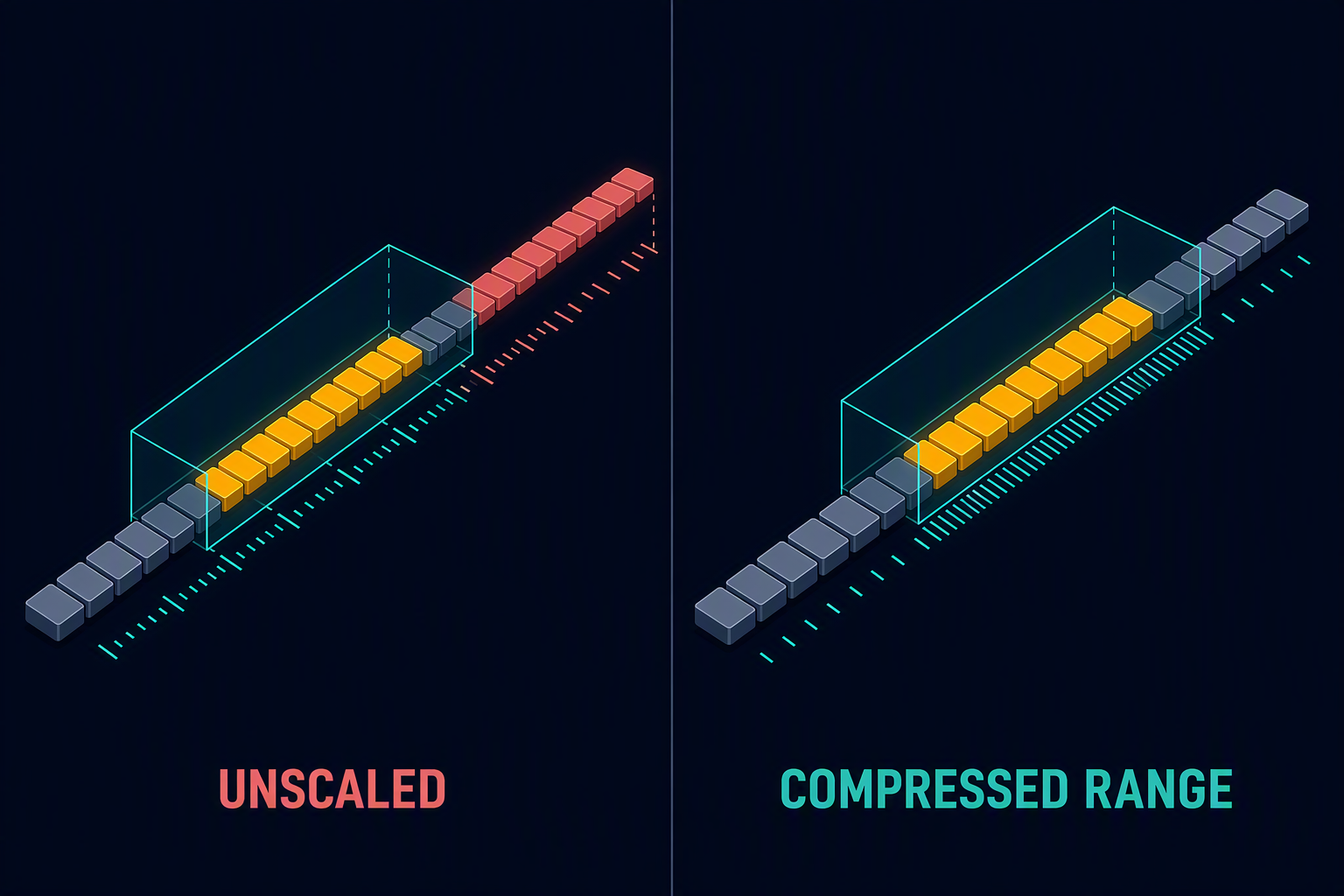
Position scaling fits a longer range by compressing positional distance.
The artifact implements simple RoPE and compares unscaled with linear position scaling. For a training window of 2,048 extended to 8,192, the scale is 0.25. The resulting dot-product curve visibly changes phase. This proves that scaling changes positional geometry. It does not prove perplexity, retrieval accuracy, or usable context.
Context is also a memory problem
Even perfect positional quality would not make longer context free. KV cache grows linearly with cached tokens:
Increasing one sequence from 4k to 32k tokens multiplies its cache by eight. Full prefill attention also performs much more work as prompt length grows. Memory-efficient kernels avoid materializing the full score matrix in HBM, but they do not remove the attention arithmetic or KV storage.
This creates three distinct meanings of “supports 32k context”: the software accepts the shape, the memory system fits the workload at required concurrency, and the model retains task quality at that distance. All three must pass.

A context claim must pass software shape, memory capacity, and model-quality tests.
Long context can fail even when average perplexity looks acceptable. A model may ignore one fact near the beginning, become sensitive to evidence position, or attend diffusely across distractors. Test controlled retrieval at several depths rather than using only documents whose answers can be guessed without reading the distant evidence.
In practice
Read the checkpoint’s trained context, RoPE base, scaling type, and scaling factor from its model card and configuration. Prefer values published with the weights. A framework accepting an arbitrary override is not evidence that the override is sound.
Evaluate long context with tasks that require information at controlled positions, plus perplexity or likelihood across length buckets. Include short-context regression: a scaling method that helps beyond the trained window may damage ordinary prompts.
Measure memory and TTFT at each length. Report concurrency because one 32k sequence fitting does not imply 50 concurrent 32k sessions fit. Track actual prompt-length distributions rather than configuring every request for the maximum.
Verify tokenizer length as well. Users think in pages or words, but cache and position limits use tokens. Languages and tokenizers produce different counts for the same visible length. Reject or truncate according to tokenized length, and make truncation visible to the caller.
Failure modes
| Symptom | Cause | Fix |
|---|---|---|
| Framework accepts long input but answers ignore distant evidence | Shape limit changed without a validated positional extension | Use checkpoint-supported scaling and run retrieval/quality tests |
| Short prompts regress after scaling | Rotation changes affected the trained range | Evaluate short buckets and use a method with appropriate correction |
| OOM appears before quality can be tested | KV cache and attention workspace grew with context | Reduce concurrency, KV heads/dtype, or maximum live tokens |
| RoPE plot is called a perplexity result | Geometry evidence was confused with model evidence | Run real checkpoint evaluation and label the plot narrowly |
| Positions are wrong only during cached decode | Cache position indices reset or advance incorrectly | Trace absolute position and cache length at every step |
Do it
Run the RoPE artifact. Verify relative displacement by shifting query and key positions together, then change the scaling factor and explain the curve. Extend the experiment with a real checkpoint before making quality claims.
Success requires separating geometric, quality, and systems evidence in the final report.
Check
- What is rotated by RoPE, and where does relative position enter the attention score?
- Why does increasing
max_position_embeddingsnot prove that a checkpoint can use the new range? - Name the three independent tests behind the statement “this model supports 32k context.”